
A newly inaugurated supercomputing facility expands access to advanced computational resources for researchers and students across Denmark via UCloud.
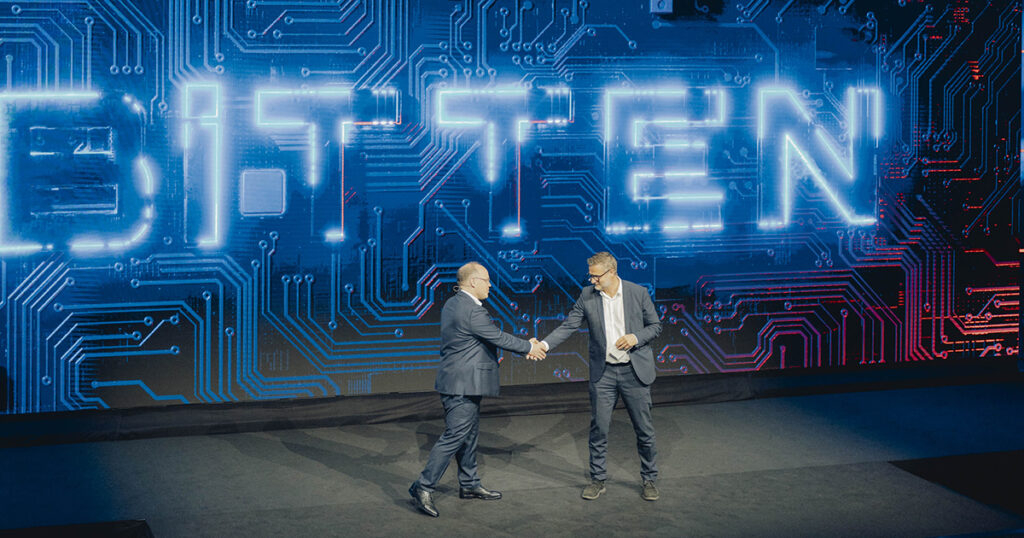
A new supercomputing facility has been inaugurated at Alsion in Sønderborg, marking an important expansion of Denmark’s digital research infrastructure. The system, named Bitten, will support research and teaching in areas such as artificial intelligence, data analytics, and advanced computing – and will be accessible to users across the country through UCloud.
By providing access via UCloud, the system becomes available within a familiar environment already used by thousands of researchers and students. Users can access advanced computing resources directly through a browser-based interface, selecting tools and applications much like in an app store — without needing to manage or understand the underlying infrastructure. This significantly lowers the barrier to entry, making high-performance computing available not only to specialists, but across disciplines.
The new setup also simplifies the user experience. Infrastructure that was previously distributed across locations is now consolidated in a single data centre, making it easier to navigate and work with computing resources.
Expanding access to advanced computing
The addition of new supercomputing capacity increases what researchers can do — and who can do it. By removing technical and practical barriers, the platform enables more researchers and students to work with large datasets, advanced models, and computational methods, accelerating the path from idea to insight, and from research to real-world application.
Just as importantly, this is made possible within a Danish digital infrastructure where data, software, and computation remain under national control. As reliance on large-scale data and AI continues to grow, questions of data governance, security, and control are becoming increasingly central — not only from a technical perspective, but as a strategic priority for research and innovation.
“Access to computing power is only part of the equation,” said Professor Claudio Pica, Director of the SDU eScience Center representing the consortium behind UCloud. “It is equally important that researchers can work within a trusted environment where data and workflows remain under national control. UCloud makes it possible to combine advanced computing with that level of trust and transparency.”

A shared platform for research and innovation
UCloud is already widely used across Danish universities, supporting a broad range of disciplines and use cases, and now serves more than 23,000 users across research fields. With the addition of new high-performance resources, the platform continues to evolve to meet the growing computational needs of research and education.
The platform also supports startups and spin-out companies by providing access to advanced AI and data analytics, improving opportunities to develop, test, and scale new solutions. In this way, the infrastructure contributes not only to research, but to innovation and competitiveness more broadly.
UCloud is developed and operated in close collaboration between the partners in the Interactive HPC Consortium, consisting of the University of Southern Denmark, Aarhus University, and Aalborg University — reflecting a long-term joint effort across Danish universities to build shared digital research infrastructure.
Part of a broader national effort
The new supercomputing facility, Bitten, is part of Denmark’s national research infrastructure and reflects ongoing collaboration between universities, industry, and technology providers. Access through UCloud plays a central role in ensuring that this investment benefits a broad user base across the country.
The facility is also designed with energy efficiency in mind. Developed in collaboration between SDU, Danfoss, and HPE, the system uses advanced liquid cooling with full heat recovery, allowing excess heat to be reused in the local district heating system. This positions the facility as an example of how digital infrastructure can actively support the energy system — turning data centres from energy consumers into integrated, value-adding components of local infrastructure.