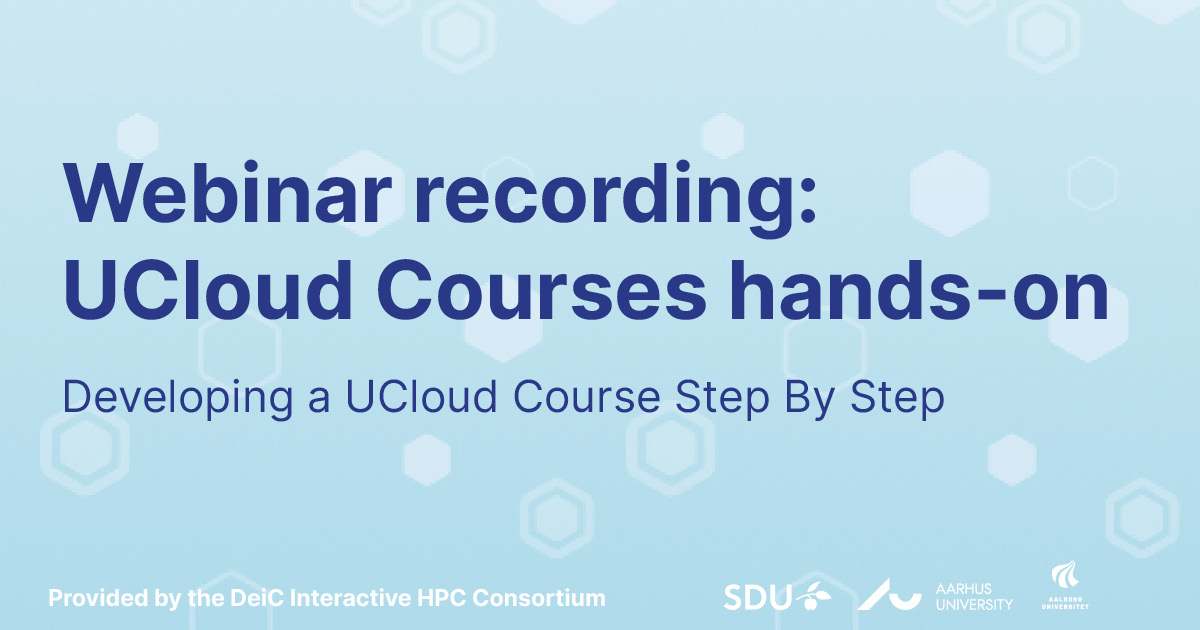
A new feature has been launched on the innovative UCloud platform, designed to provide a seamless and efficient learning experience for both educators and students. If you are teaching a course at a Danish University and would like to have a setup ready to use for students with all the necessary tools pre-installed and easy access to lectures and teaching materials, the new UCloud course feature is perfect for you.
Cloud-Based Learning: A virtual “lab” for your class
UCloud leverages the power of cloud computing to offer a robust and scalable environment for courses. The new UCloud course feature means that you can focus on teaching while UCloud handles the infrastructure, ensuring a smooth and uninterrupted learning experience.
Whether you are teaching data science, machine learning, natural language processing or any other subject, UCloud supports a wide range of tools and applications. This flexibility allows you to integrate your preferred software and resources effortlessly.
“A course on UCloud is essentially like having a lab for the class. Everything needed is already installed and the students can easily choose the appropriate resources in terms of teaching materials and installation libraries,” says Dr. Federica Lo Verso, Computational Scientist at the SDU eScience Center and part of the Research Support Team.
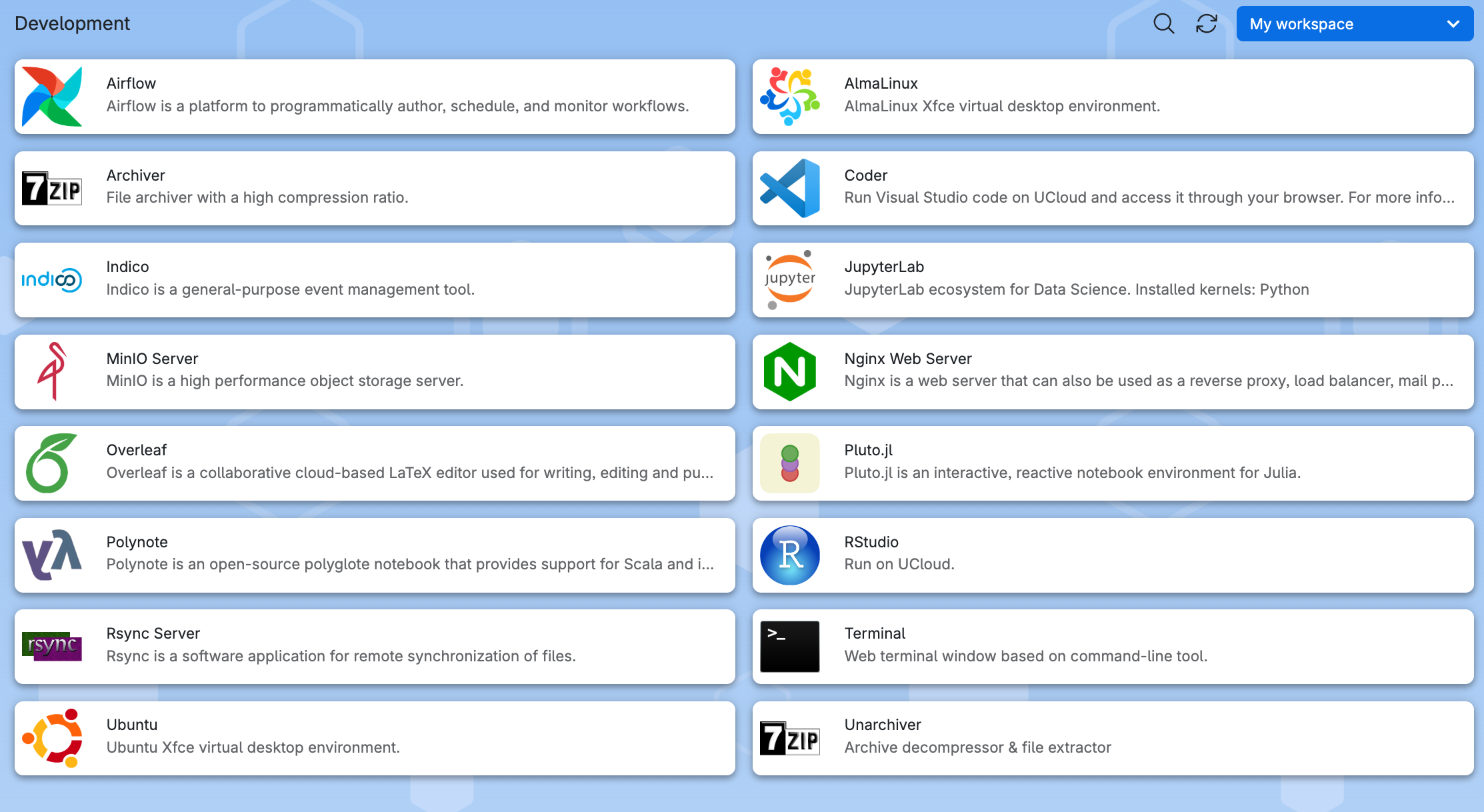
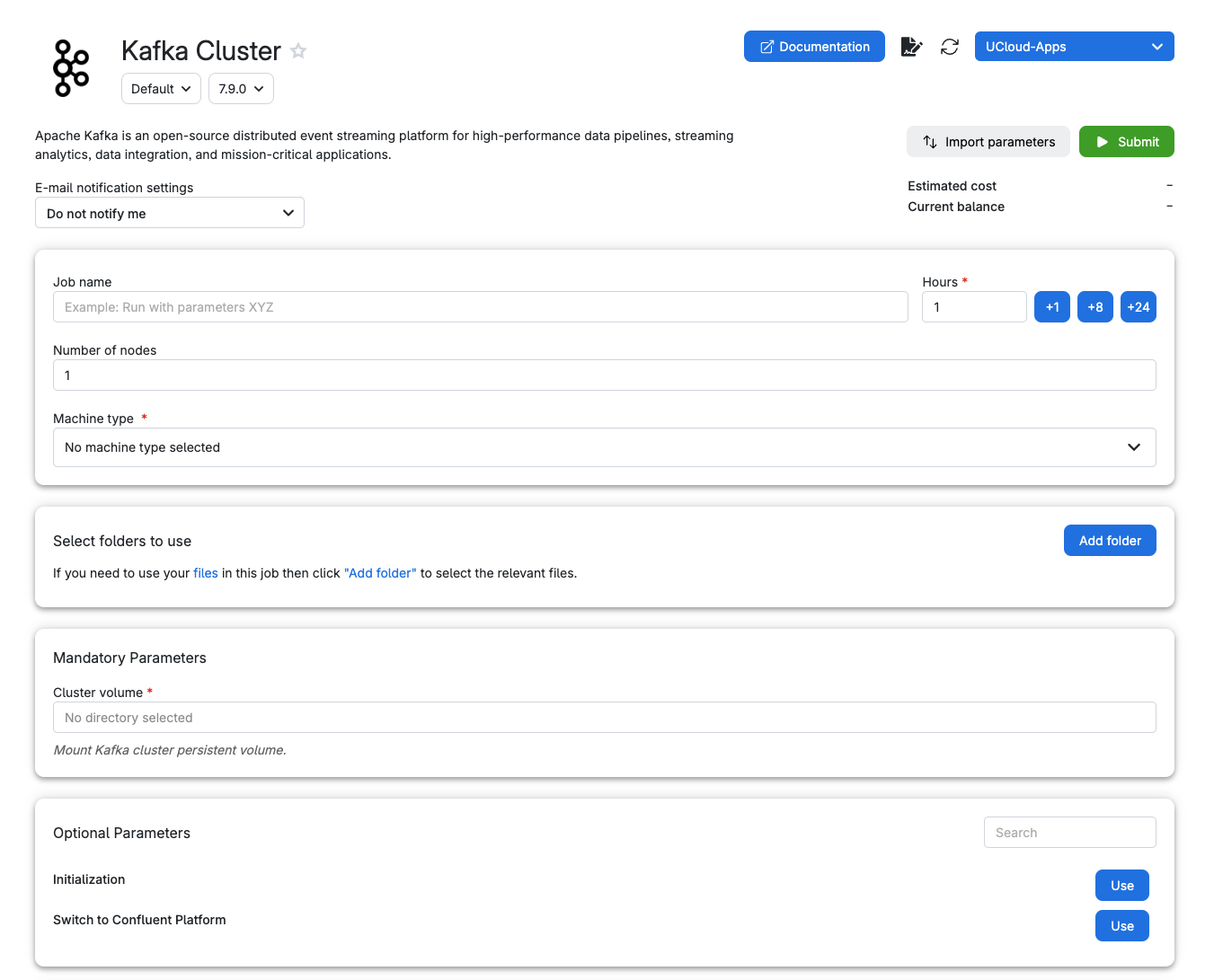
Once the course is on UCloud, it can be found in the App Store in the section “Courses” under “Browse by category”.
An example of a “Course” selection is the one below which contains a course from AU. All the relevant software packages, notebooks, scripts etc. for the course are already ‘wrapped’ into the app, which allows students to access the full material quickly and seamlessly without having to install any software themselves.
For the full story about hosting courses on UCloud:
With 10,000 users, DeiC Interactive HPC has established itself as one of Europe’s most popular HPC facilities, thanks to an unprecedented democratisation of access to advanced computing resources. These resources, once reserved for specialised research fields and technically adept specialists, are now accessible to any researcher with a dataset and a vision.
Through a newly developed, simple, and graphical user interface, DeiC Interactive HPC, also known as UCloud, makes it easier than ever to gain interactive access to supercomputing. This approach reduces technical barriers and enhances research collaboration by offering shared, easily accessible virtual environments. As a result, DeiC Interactive HPC supports dynamic and interdisciplinary research, accelerating research processes and promoting innovation in fields ranging from bioinformatics to digital humanities.
Democratising Access to HPC
The trend towards more interactive use of technology, including HPC, reflects efforts to make the STEM field more inclusive and accessible, mirroring broader societal changes towards diversity and inclusion in technology and science. DeiC Interactive HPC’s user-friendly approach has attracted a broad spectrum of users, including those from nearly all Danish universities and individuals with varying levels of technical expertise, notably many students.
“We are proud to highlight the growing diversity among DeiC Interactive HPC users, a development that further distinguishes DeiC Interactive HPC from traditional HPC systems. We see continuous growth in user numbers and are now celebrating surpassing 10,000 users across a very broad spectrum of research disciplines, which is impressive in the HPC field. Of these users, 50% are students, reflecting DeiC Interactive HPC’s success in attracting new users and serving as a bridge to larger European HPC facilities,” says Professor Kristoffer Nielbo, representing Aarhus University in the DeiC Interactive HPC Consortium.
Research AreasStudents
By simplifying access to supercomputers, DeiC Interactive HPC democratises powerful data processing resources, enabling a wider range of researchers and academics to conduct innovative research without the steep learning curve traditionally associated with HPC. This inclusivity fosters scientific collaboration and creativity, enriching the HPC community with a diversity of perspectives and ideas.
“We continuously work to improve DeiC Interactive HPC with a democratic approach, using user feedback to ensure our focus is in the right place. This is also reflected in our new update – UCloud version 2 – which aims to increase efficiency and improve the user experience for researchers. It is part of our DNA as an interactive HPC facility to always keep the user in mind and develop apps and user interfaces based on user needs. Therefore, we encourage our users to reach out to us with their wishes and ideas,” says Professor Claudio Pica, representing the University of Southern Denmark in the DeiC Interactive HPC Consortium.
Did You Know
– that DeiC Interactive HPC provides resources for developing large AI language models through initiatives such as Danish Foundation Models (DFM) and the new Danish Language Model Consortium?
– that nearly 80 apps are available via UCloud’s App Store, including the Chat-GPT-like app, Chat-UI, and transcription tools Transcriber and Whisper Transcription?
– that 25% of users on Interactive HPC come from the Social Sciences & Humanities, a unique figure as HPC traditionally caters almost exclusively to Natural Science, Health/Life Science, and Engineering?
An All Danish and Highly Secure System
Despite its internationally sounding name, UCloud, DeiC Interactive HPC is part of the Danish HPC landscape, funded by Danish universities and the Ministry of Education and Research. The increased focus on developing a new generation of highly user-friendly applications means that researchers and other university staff can now use intuitive applications for transcribing sensitive data via DeiC Interactive HPC.
“DeiC Interactive HPC has already developed applications based on the same transcription technology found online and made them available in a secure environment through the UCloud platform. These transcription applications are just the beginning of a series of targeted secure applications that do not require prior experience, and we are always open to user input and ideas that arise from their unique needs but often prove beneficial to many,” says Lars Sørensen, Head of Digitalisation, representing Aalborg University and CLAAUDIA in the DeiC Interactive HPC Consortium.
By making advanced data processing more accessible to researchers from various disciplines, DeiC Interactive HPC helps break down the technical barriers that previously limited access to these resources. With an increasing number of students and new users from diverse backgrounds combined with continuous engagement in user-centred innovation, DeiC Interactive HPC not only supports the academic community but also plays a crucial role in promoting a more inclusive and productive research environment.
New usersUniversities
For further information and high resolution graphics, contact: Kristoffer Nielbo, Director of Center for Humanities Computing, Aarhus University, 26832608 kln@cas.au.dk
About DeiC Interactive HPC (UCloud)
UCloud offers access to advanced tools such as quantum simulation apps and H100 GPUs as well as applications aimed at data analysis and visualisation.
In data analysis, Python and Jupyter notebooks are particularly prominent, catering to the interactive, ad hoc, and data-centric workflows common in the field. These tools are highly valued for their user-friendliness in handling rapidly changing software environments and offer rich user interfaces, a significant advantage compared to traditional HPC setups, which can be more complex or less flexible.
Furthermore, the integration of tools such as Conda for managing software packages, Jupyter notebooks, Rstudio, Coder, and Dask for parallel computing significantly enhances the usability of HPC resources for interactive and on-demand data processing needs. These tools help bridge the gap between the hardware of complex HPC systems and the user-friendly software environments that data scientists require.
Denmark has marked a significant milestone in computational research with the addition of 16 NVIDIA H100 GPUs to the DeiC Interactive HPC service, and 16 more are expected by the end of the year. The tender for the acquisition of the GPUs was awarded to Lenovo. This addition signifies a big leap forward for Danish researchers, who can now easily access the new GPUs through UCloud, and positions Denmark at the forefront of AI innovation. We recently had the privilege of talking with Dr. Valerio Rizzo, head of AI & SME at Lenovo’s EMEA (Europe, Middle East and Africa) division, about the AI revolution that is currently taking place and Lenovo’s role in the production of the world’s most powerful hardware for AI.
Collaboration between Lenovo and NVIDIA
NVIDIA is the company behind the industry-leading graphics processing unit (GPU), H100, currently the most sought-after hardware for AI and used extensively by some of the biggest AI companies in the world, including OpenAI, Microsoft and Google. H100 is generally 2-3 times faster than the previous A100 generation, and an impressive 30 times faster for AI workloads such as large language models (LLM). The recently announced supercomputer, Gefion, by Novo Nordisk Foundation (NNF) and the Export and Investment Fund of Denmark (EIFO) will make use of the same technology.
In the past, Danish researchers had to either search abroad or pay commercial cloud providers expensive fees to use these powerful machines. However, since January this year the 16 H100 GPUs have been available via the DeiC Interactive HPC service, provided by a consortium of universities consisting of Aarhus University (AU), Aalborg University (AAU) and the University of Southern Denmark (SDU). The H100 GPUs are hosted at the SDU data center and available via the user-friendly platform, UCloud, that powers the DeiC Interactive HPC service…
Streamline your workflow when using DeiC Interactive HPC
Have you ever experienced delays due to high demand for computing resources on UCloud (DeiC Interactive HPC)? The key to faster access and reducing system strain is efficient resource management.
Over-requesting can lead to unnecessary waiting because DeiC Interactive HPC operates by allocating resources to users as the requested resources become available, without the use of priority queues. Consequently, if you select a large machine for a relatively small task, you will need to wait for other tasks requested for these larger but fewer machines to finish, leading to prolonged waiting.
“Users with little or no experience in assessing the amounts of resources needed have a tendency to request more than they actually need. This causes unnecessary queues and frustration for other users. However, we also see experienced users choosing the large machines simply out of habit instead of starting small, and subsequently migrate to a larger machine only when necessary.”
Jes Elgin, Cloud Engineer at DeiC Interactive HPC
To avoid delays, users need to accurately assess and request only the necessary resources for their task. Starting with conservative estimates can expedite access and improve overall system efficiency.
“Choosing small will always give you a head start as there are more small machines, and you can always upgrade to a large machine if you need it. You don’t have to start over, and you won’t lose any data.”
Jes Elgin, Cloud Engineer at DeiC Interactive HPC
**TIP!** Did you know that the likelihood of obtaining a machine right away is higher the less resources you request?
So, choose your machine based on a qualified estimate of resources needed. If unsure start small and seek advice from experienced colleagues or the DeiC Front Office.
DeiC Interactive HPC has achieved another remarkable feat: it now has more than 9000 users! The graph shows the rapid and steady growth of the user base, which has tripled in just two years. More about this new milestone here
The first national call for HPC resources H2-2024 is now open.
As a researcher at a Danish university, you have various options for gaining access to computing power at both Danish and international HPC facilities.
Deadline for application is 12. March. For more information, visit DeiCs website.
Recently two advanced quantum computing applications were deployed on DeiC Interactive HPC: the NVIDIA CUDA Quantum Platform and the NVIDIA cuQuantum Appliance.
These applications show the continuous commitment to offer cutting-edge technologies to the Interactive HPC users.
“With these new applications, DeiC Interactive HPC is at the forefront of bringing quantum computing into practical, real-world use,” says Emiliano Molinaro, leader of research support at the SDU eScience Center. “The platform is now uniquely equipped to support the development of quantum algorithms and simulations, offering unprecedented level of computational power and flexibility.”
We hope that DeiC Interactive HPC’s deployment of these NVIDIA applications will be useful for a wide array of users, from academic researchers to industry professionals, seeking to explore the uncharted territories of quantum computing. It represents not only an enhancement of DeiC Interactive HPC’s offerings but also a significant contribution to the Danish quantum computing ecosystem.
Historian Adela Subotkova teaches history students at the University of Aarhus in digital methods. For her, DeiC Interactive has become an essential tool that has significantly facilitated and improved teaching.
Interactive HPC hits another milestone: There are now more than 8000 users! This is an increase of 1000 users during less than 3 months!
The activity on the platform has been sky-high during the past few weeks – possibly amplified by the many researchers who praised the platform and inspired others at the DeiC conference on the 7-8th of November.
Sociologist Rolf Lyneborg Lund has trained an image AI using DeiCInteractive, which can help us understand how people perceive the concepts of “good” and “bad” neighbourhoods.