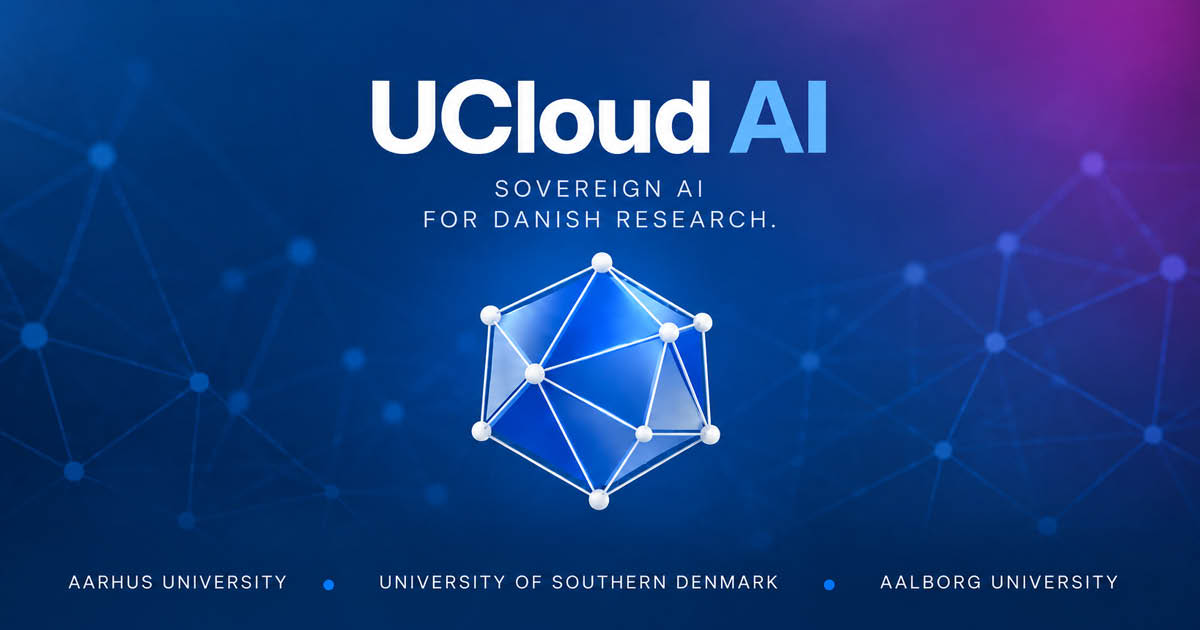
UCloud AI brings advanced language models, national supercomputing power and secure digital infrastructure together in one platform. Developed as a public service rather than a commercial AI product, the new platform aims to make artificial intelligence more accessible to researchers across Denmark.
Odense/Aarhus/Aalborg, 14 September 2026.
Artificial intelligence is creating new opportunities across research, industry, and the public sector. Making use of the technology often requires access to powerful computing resources, specialist expertise and solutions that can handle data securely. With the launch of UCloud AI, the Danish universities are bringing these capabilities together in a new sovereign AI platform.
Developed by the University of Southern Denmark, UCloud AI is integrated into the national research platform UCloud and runs on the AI supercomputer BITTEN located in Sønderborg. It provides access to advanced language models through a familiar digital workspace, allowing users to work with AI alongside their existing data, storage, and applications. The service builds on the existing collaboration between SDU, Aarhus University and Aalborg University in the DeiC Interactive HPC consortium.
The platform is designed to support a wide range of users and purposes. At launch, researchers and students at Denmark’s eight universities can access the service through their existing university login, and in a little while also companies and organizations, or people who simply need a secure and accessible way to use the technology, will also be able to gain access to the service.
“Our ambition is to make advanced AI available to everyone who can benefit from it, not only to those who have the technical expertise or resources to build their own infrastructure. With UCloud AI, we are bringing powerful models, computing resources and a secure digital environment together in one place. It is a public service built on Danish infrastructure, where users can work with AI without giving up control of their data or intellectual property, at a significantly lower cost than other providers. We believe this can open up entirely new possibilities for research, innovation and the wider society”, Says Claudio Pica, Professor and Director of the SDU eScience Center at the University of Southern Denmark.
SDU will also collaborate with the Danish Centre for AI Innovation (DCAI), which owns and operates Gefion, Denmark’s national AI supercomputer. Researchers whose projects need to scale or have specialized computing requirements will be able to also access Gefion through UCloud AI. This collaboration points toward a future in which several supercomputing infrastructures could be accessed through a single platform, giving researchers greater flexibility and creating new opportunities for ambitious research and innovation.
Public, sovereign AI infrastructure built for sensitive work
UCloud AI is open source and operates within UCloud’s existing security framework and data processing agreements. AI processing takes place in Denmark, supporting sensitive research and organizational work while reducing dependence on external commercial providers. The platform combines AI models, data, storage, and HPC resources in one environment, with both a chat interface and an OpenAI-compatible API for developing more advanced applications.
“AI is a strategic priority across all Danish universities, and if we want to remain at the forefront of research and innovation, we also need the sovereign infrastructure to support that ambition. UCloud AI gives researchers access to advanced AI while keeping control of data and critical infrastructure in Denmark. This strengthens our ability to develop knowledge and technology on our own terms and, ultimately, to create value for society as a whole,” says Jens Ringsmose, Rector of the University of Southern Denmark and Chair of Universities Denmark.
“Secure and accessible AI infrastructure is becoming increasingly important for Danish research. From Aalborg University’s perspective, UCloud AI is an interesting addition to the national research infrastructure and a good example of how existing collaboration can give researchers access to new capabilities,” says Thomas Bak, Dean of the Technical Faculty of IT and Design at Aalborg University.
UCloud users are ready for the new platform
At Aarhus University, researchers have already used UCloud to investigate how language models respond to more than 3,000 dilemmas from the radio programme Sara & Monopolet, examining how closely their advice resembles that of the human panel. Another example is Lex.llm, a collaboration with Lex.dk exploring how generative AI can be combined with quality-assured Danish knowledge. UCloud AI will make it easier for projects such as these to access models and develop applications without establishing their own model infrastructure.
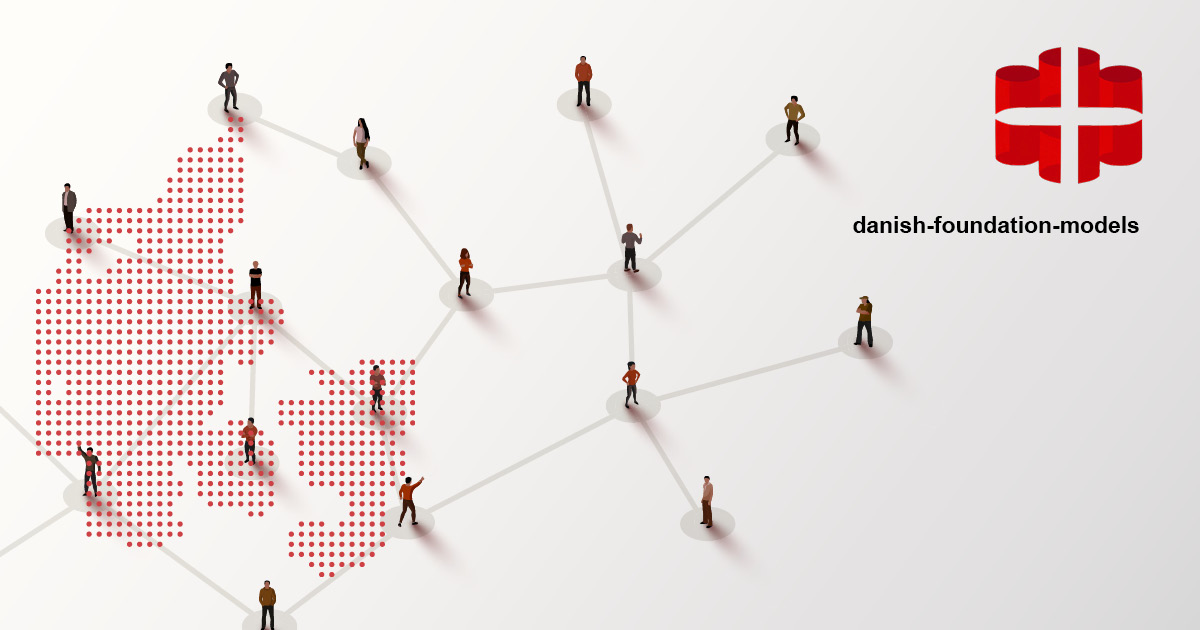
The platform will also provide an important link to Danish Foundation Models (DFM), a national research initiative developing open Danish language models. By making models developed through DFM available directly in UCloud AI, the same infrastructure can support the entire journey from developing and testing new AI models to making them accessible for research and new applications.
“Fluent Danish is only part of what we need from a language model. We also need to understand how it handles Danish knowledge, social norms and cultural context. Model development and practical application need to inform each other: we need access to competitive open models that we can evaluate and integrate into applications, while experience from those applications helps us identify where the models need to improve. UCloud AI provides an important connection between these activities, allowing us to study AI systematically and build with it, while reducing dependence on commercial API providers and giving us greater control over the models we use,” says Kristoffer Nielbo, Professor and Head of the Center for Humanities Computing at Aarhus University and Research Lead for Danish Foundation Models.
Facts about UCloud AI
Operated by: Developed and operated by the SDU eScience Center. UCloud forms part of the infrastructure used in the DeiC Interactive HPC Consortium involving SDU, Aarhus University and Aalborg University.
Platform: Built on UCloud, serving more than 25,000 researchers and students since 2020.
Computing infrastructure: Runs on BITTEN in Sønderborg, established by SDU in collaboration with Danfoss and Hewlett Packard Enterprise, serving as a model for integrating digital infrastructure with sustainable energy systems. Through an agreement with DCAI, projects requiring additional scale or specialized computing capabilities will also be able to access Gefion, Denmark’s national AI supercomputer, through UCloud.
Open source and security: UCloud is open source under the EUPL license and ISO/IEC 27001:2022 certified.
Cost: UCloud AI is designed to provide AI resources at a substantially lower cost than comparable commercial services. Access is managed through a transparent credit-based allocation model.
Launch website: https://ai.escience.sdu.dk/
For further information please contact:
Professor Claudio Pica: pica@cp3.sdu.dk