The purpose of this webinar is to demonstrate how to perform automated text classification using pre-trained, open-source large language models (LLMs). The efficiency that This webinar demonstrates how to perform automated text classification using pre-trained, open-source large language models (LLMs). The use case is classification of text according to sentiment, but the general workflow is applicable to many other text classification tasks.
In the webinar, it is demonstrated how to:
Retrieve text data from online sources
Store and prepare the data for analysis
Set up an LLM text classifier
Perform the text classification
Use a web app for human validation of the classification result
Time stamps:
00:00: Introduction and agenda 02:04: Terminology and UCloud workflow outline 08:30: Best practices in web scraping 11:30: Setting up the UCloud workflow 18:30: Scraping and storing the data 27:06: Setting up the the classification pipeline 42:15: Classifying the data and analyzing the results 57:27: Creating a web app for result validation by humans
In the Master’s programme in Cognitive Science at Aarhus University, UCloud plays a central role in teaching Natural Language Processing (NLP). For instructor and PhD student Mina Almasi, the platform is essential in enabling students to work hands-on with complex models – regardless of the limitations of their own computers.
From Theory to Hands-On Learning
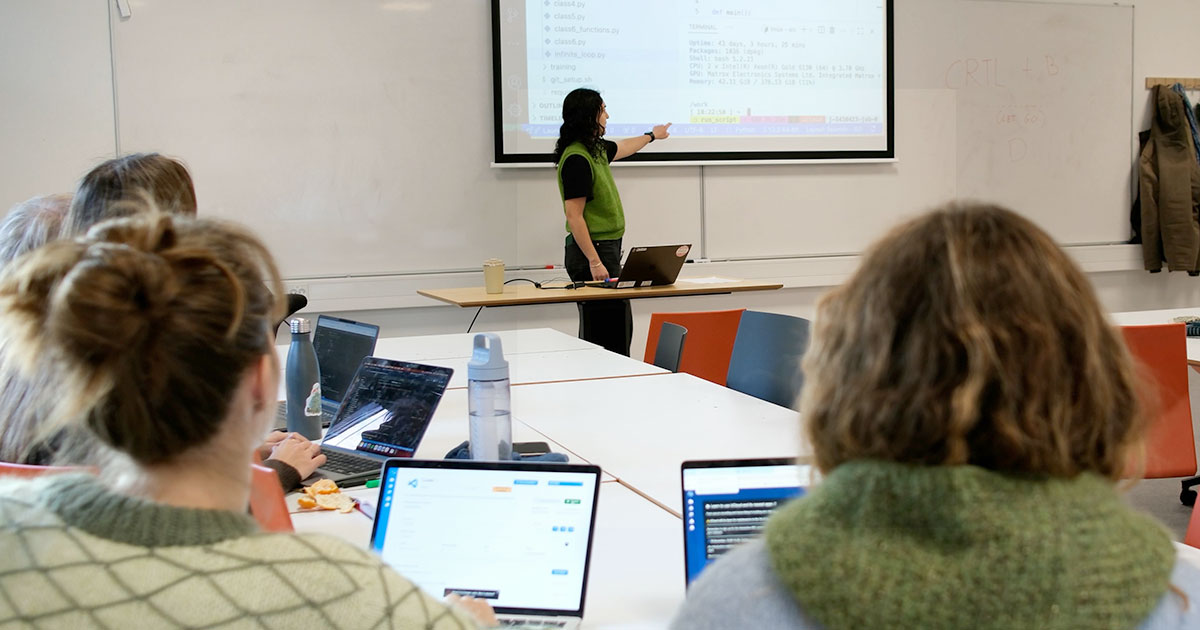
In a white classroom in Nobelparken, Mina stands in front of 15 students. On the screen behind her, lines of Python code appear in neat, symmetrical rows as she explains which code libraries the students need to access.
In her teaching, she uses the Coder Python application in UCloud because the course is based on Python programming. But the choice of platform is not just about software – it is about giving students the opportunity to translate theory into practice.
According to Mina, NLP teaching previously tended to remain at a more theoretical level, due to limited access to both models and the computing power needed to test theories in practice – especially when it came to large language models. With UCloud, students can now work directly with language models (LLMs) and make use of powerful GPUs and CPUs. This allows them to test theories themselves and experiment hands-on with the tools they are learning about.
“We still teach the theory, but now we can also have students use the tools in practice. They can code on their own and gain insight into how a large language model works by working directly with it through UCloud,” she explains.
A Standardised Setup that Democratises the Classroom
Another advantage of using UCloud in NLP teaching is that the platform ensures equal access for all students, regardless of the computer they own.
“There is a kind of democratisation of the classroom, because you don’t need the latest computer. You can use a five-year-old machine to run very heavy tasks that the newest tools in Natural Language Processing require,” she explains.
At the same time, the standardised setup makes teaching more seamless. All students work with the same standard configuration in UCloud, so any issues that arise are the same for everyone. This creates a shared sense of problem-solving, as challenges can be addressed collectively rather than handled individually by students on their own. As Mina puts it:
“Instead of stopping the lesson to solve individual problems, the problems become collective and an opportunity for learning for everyone. If we have a software issue – for example, a Python library version that is outdated or incompatible – it affects everyone, and we can solve it together.”
Preparing Students for Working Life
For Mina, using UCloud also helps prepare students for the reality that awaits them after graduation. According to her, many of the students who go on to IT positions will likely use cloud computing platforms rather than coding on local machines. In this way, the teaching becomes direct preparation for future job tasks and gives students experience with the technologies they will encounter in practice.
Advice for Other Instructors
Mina has used UCloud since her bachelor’s degree and finds that the platform makes teaching both smoother and more engaging.
“I recommend that other instructors make use of the platform. You just have to get started – but feel free to ask colleagues for advice on how they use it. Get some inspiration, because UCloud is a fantastic tool. It can do a great many things, but like other systems, it can feel a bit overwhelming at first, so it’s a good idea to get some guidance along the way before you begin.”
By Jasper Riis-Hansen and Line Ejby Sørensen, Center for Humanities Computing (CHC), Aarhus University
DeiC Interactive HPC – UCloud plays a central role in the Danish Foundation Models (DFM) project, which forms part of the Danish government’s strategic initiative for artificial intelligence.
Danish Foundation Models (DFM) is supported by the Ministry of Digital Affairs as part of the national AI strategy, which aims to ensure that Denmark has access to advanced and tailored language models. These models are intended for use across a wide range of sectors, including healthcare, public administration, education, and private enterprise.
A shared digital environment
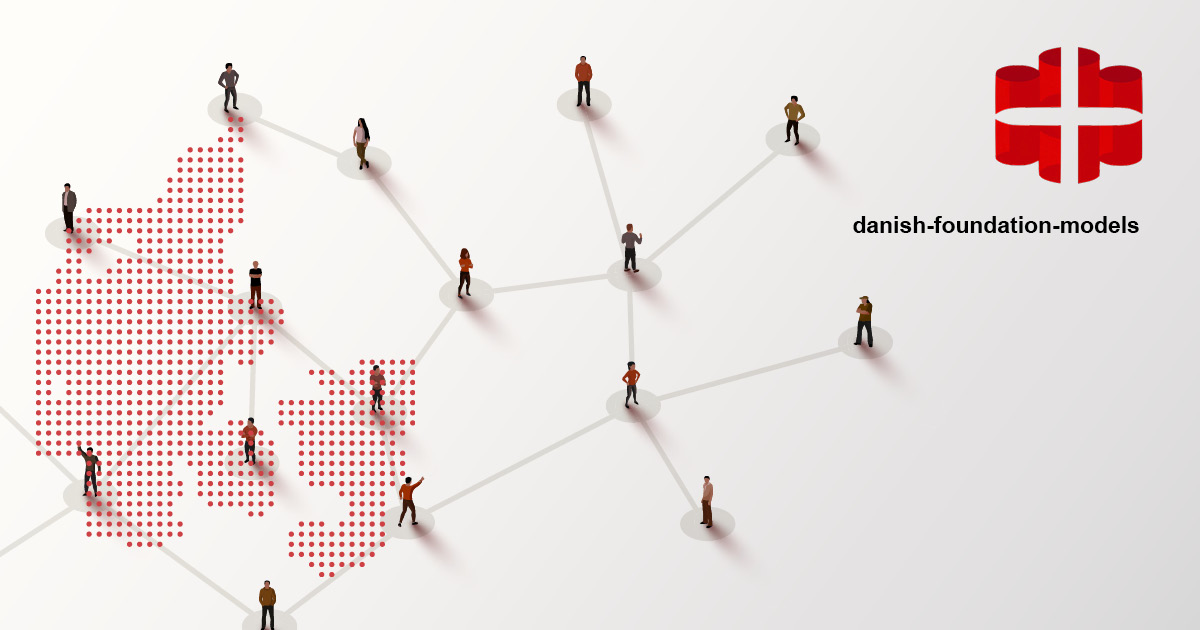
The DFM project brings together Danish universities, research institutions, and industry partners in a joint effort to establish new standards for ethically responsible and inclusive AI language technologies.
The project is a collaboration between Aarhus University, the University of Copenhagen, the University of Southern Denmark, and the Alexandra Institute. DeiC Interactive HPC – UCloud plays a vital role in this work by providing high data security, scalable computing power, and, not least, an accessible, secure, national cloud platform that enables collaboration among project partners.
“UCloud forms the foundation for an important step in research digitalisation, as the platform provides easy access to computing power, enabling scalable data analysis and modelling, while also offering a secure environment for handling sensitive data. The platform also facilitates collaboration across institutions and allows us to manage data access as needed. This is particularly relevant in the DFM project, which includes many partners participating at different levels.” Postdoc Kenneth Enevoldsen
Data security and computing power
Because AI models are often trained on sensitive data, it is crucial that data processing complies with both GDPR and Danish security standards. UCloud is ISO27001-certified and specifically designed to meet both Danish and EU requirements for secure data handling.
“In the DFM project, we work with very large amounts of data from a variety of sources – including sensitive data that the models are trained on – and this places high demands on data security. That is why UCloud is such a valuable tool for the project – precisely because of its high level of data security and access to scalable computing power.” Postdoc Kenneth Enevoldsen
Although DFM also makes use of European supercomputers such as LUMI in Finland and Leonardo in Italy, the day-to-day operations of the project are heavily reliant on UCloud. In addition to being a springboard for high-performance computing, UCloud also provides a secure and user-friendly platform with a wide range of accessible applications – all essential for daily research, collaboration, data processing, and innovation across the project’s interdisciplinary team.
Critical infrastructure for Danish AI development
DFM’s principal investigators, Kristoffer Nielbo and Peter Schneider-Kamp, emphasise that the robust digital research environment provided by DeiC Interactive HPC – UCloud constitutes critical infrastructure. It streamlines workflows, enhances collaboration, and accelerates the development of both language and AI technologies.
“Without UCloud, the DFM project would have had to develop this type of digital infrastructure itself – with significant time and financial costs. The platform’s role in the project clearly demonstrates how robust, collaborative digital research environments are essential to Denmark’s AI strategies.”
FACTS: Danish Foundation Models (DFM)
Danish Foundation Models (DFM) is a collaborative project involving Aarhus University, the University of Copenhagen, the University of Southern Denmark, and the Alexandra Institute.
The project is supported by the Ministry of Digital Affairs with a grant of DKK 30.7 million and aims to develop advanced language models with open access and transparent development processes.
The models are specifically tailored to Danish and other Scandinavian languages and cultures and are intended for use across sectors such as healthcare, public administration, education, and business.
DFM seeks to establish a new standard for ethically responsible, inclusive, and transparent AI language technology – for the benefit of both Danish society and the research community.