
Categories
Interactive HPC Research Supercomputing Teaching UCloud Use case

UCloud Provides Student Access to Advanced NLP in Teaching 

In the Master’s programme in Cognitive Science at Aarhus University, UCloud plays a central role in teaching Natural Language Processing (NLP). For instructor and PhD student Mina Almasi, the platform is essential in enabling students to work hands-on with complex models – regardless of the limitations of their own computers.

From Theory to Hands-On Learning 

In a white classroom in Nobelparken, Mina stands in front of 15 students. On the screen behind her, lines of Python code appear in neat, symmetrical rows as she explains which code libraries the students need to access.
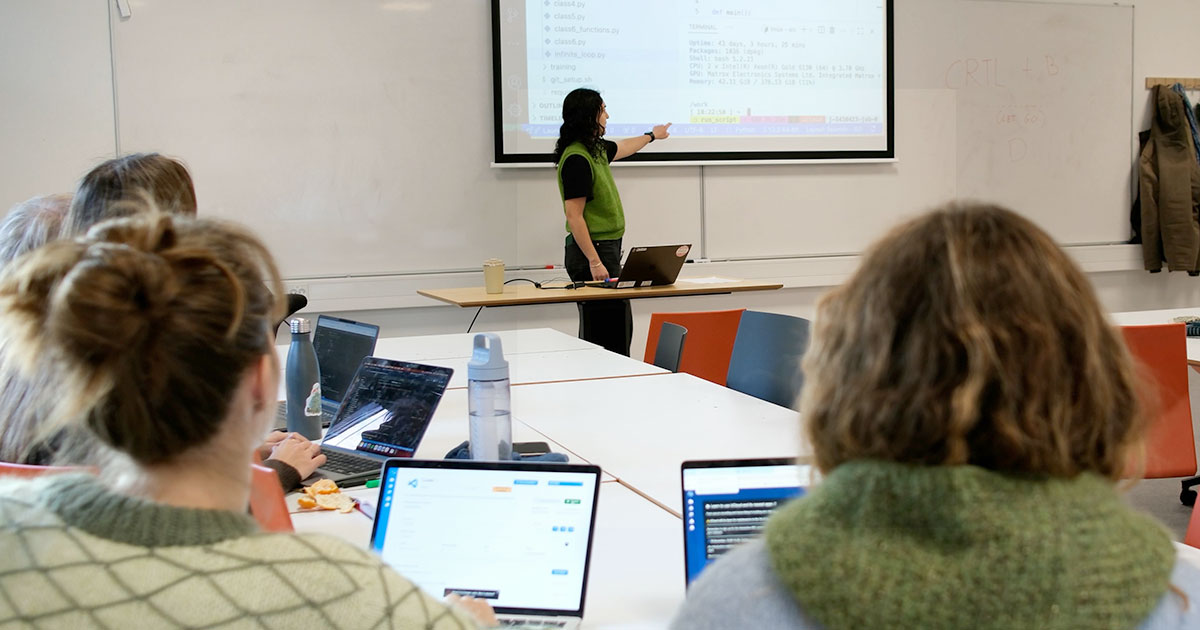
In her teaching, she uses the Coder Python application in UCloud because the course is based on Python programming. But the choice of platform is not just about software – it is about giving students the opportunity to translate theory into practice.

According to Mina, NLP teaching previously tended to remain at a more theoretical level, due to limited access to both models and the computing power needed to test theories in practice – especially when it came to large language models. With UCloud, students can now work directly with language models (LLMs) and make use of powerful GPUs and CPUs. This allows them to test theories themselves and experiment hands-on with the tools they are learning about.

“We still teach the theory, but now we can also have students use the tools in practice. They can code on their own and gain insight into how a large language model works by working directly with it through UCloud,” she explains.

A Standardised Setup that Democratises the Classroom 

Another advantage of using UCloud in NLP teaching is that the platform ensures equal access for all students, regardless of the computer they own.

“There is a kind of democratisation of the classroom, because you don’t need the latest computer. You can use a five-year-old machine to run very heavy tasks that the newest tools in Natural Language Processing require,” she explains.

At the same time, the standardised setup makes teaching more seamless. All students work with the same standard configuration in UCloud, so any issues that arise are the same for everyone. This creates a shared sense of problem-solving, as challenges can be addressed collectively rather than handled individually by students on their own. As Mina puts it:

“Instead of stopping the lesson to solve individual problems, the problems become collective and an opportunity for learning for everyone. If we have a software issue – for example, a Python library version that is outdated or incompatible – it affects everyone, and we can solve it together.”

Preparing Students for Working Life

For Mina, using UCloud also helps prepare students for the reality that awaits them after graduation. According to her, many of the students who go on to IT positions will likely use cloud computing platforms rather than coding on local machines. In this way, the teaching becomes direct preparation for future job tasks and gives students experience with the technologies they will encounter in practice.

Advice for Other Instructors 

Mina has used UCloud since her bachelor’s degree and finds that the platform makes teaching both smoother and more engaging.

“I recommend that other instructors make use of the platform. You just have to get started – but feel free to ask colleagues for advice on how they use it. Get some inspiration, because UCloud is a fantastic tool. It can do a great many things, but like other systems, it can feel a bit overwhelming at first, so it’s a good idea to get some guidance along the way before you begin.”

Categories
Interactive HPC Supercomputing UCloud UCloud status

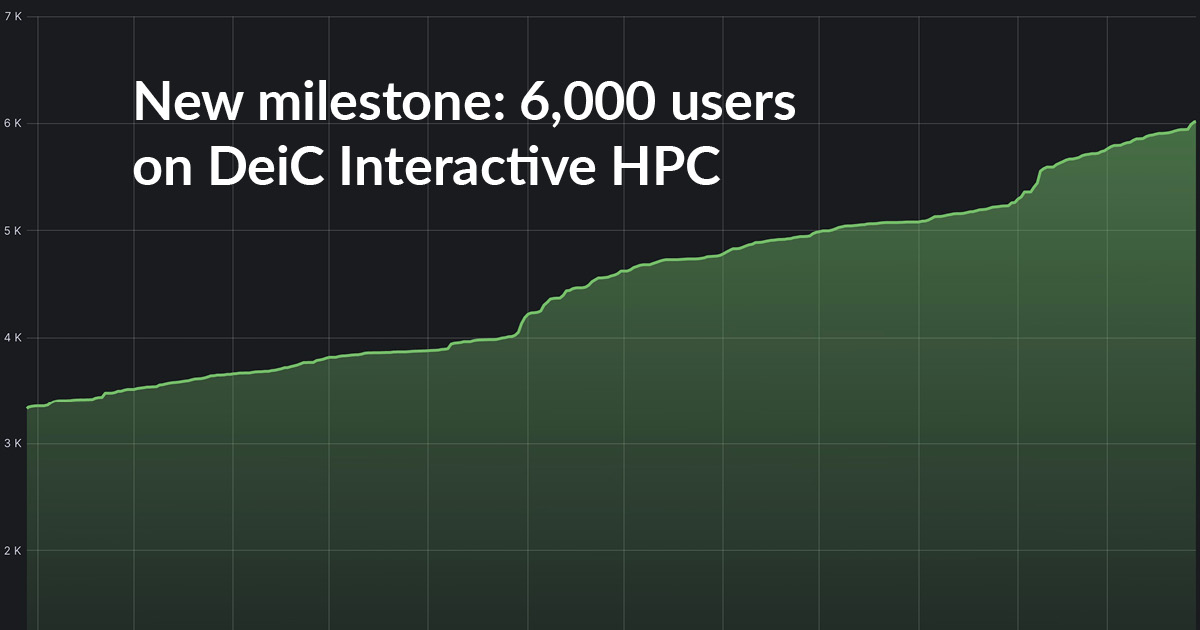
New milestone as DeiC Interactive HPC reaches 6,000 users

Recently, the DeiC Interactive HPC consortium (which consists of Aarhus University, Aalborg University and the University of Southern Denmark) posted a news story about the user overload on the service. This is an issue arising from the very positive fact that the popularity of the DeiC Interactive HPC service is increasing, but it also has the unfortunate effect that some users are now experiencing longer waiting time on the machines than usual.

Needless to say, however, the DeiC Interactive HPC consortium is immensely proud of the success of the service – and now it can also announce that the UCloud platform, which is used to provide the DeiC Interactive HPC service, has passed 6,000 users. So many users on a service which has only been operational for 2,5 years is a great achievement.

“Overall, we’re seeing an increase in the number of new users at nearly all the 8 universities in Denmark. One significant factor for the past few months is that the number of users from Copenhagen University, which has not been using the facility extensively so far, is now increasing at a steady pace. This is both great news, but also a warning sign for us, as KU is a big university and we will need to be prepared to accommodate even more users in the future.”

Prof. Claudio Pica, director of the SDU eScience Center and DeiC Interactive HPC Consortium representative

Another factor, which causes significant spikes in the number of new users at the start of every semester, is the number of students who log on the service because the UCloud software is used as part of their courses.

The consortium is working hard to add more hardware to the DeiC Interactive HPC service to alleviate the current periods of overload. In the meantime, you can find a number of tips for how to avoid overload issues here.

This update was originally posted by the SDU eScience Center.

Categories
Interactive HPC UCloud UCloud status

The cost of success – user overload on DeiC Interactive HPC


While there was never any doubt that DeiC Interactive HPC would be a success, the popularity of the HPC facility has taken the Interactive HPC consortium a little by surprise. The two-year old system reached no less than 5000 users back in December, and while every milestone is celebrated the rapid success also comes with a price. 

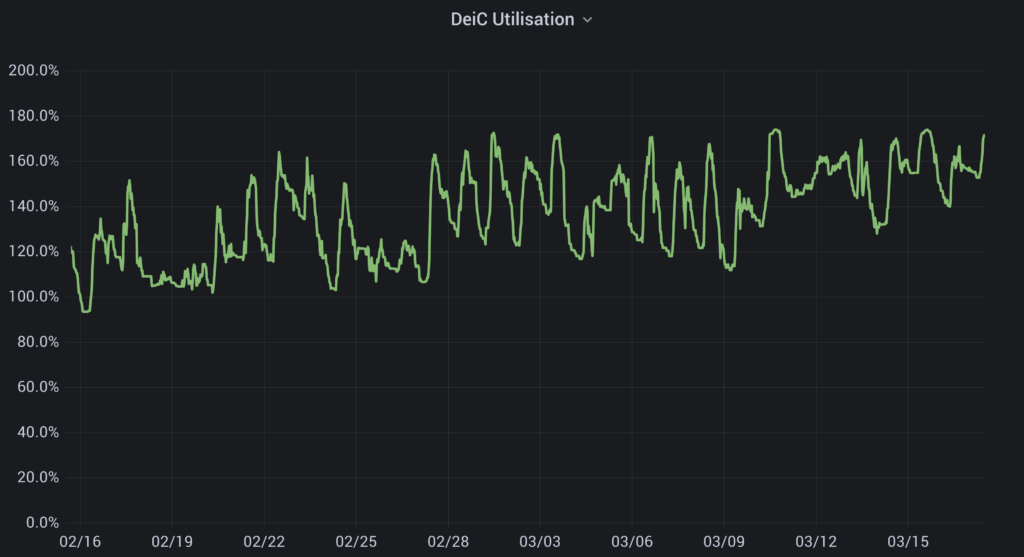
We’re seeing an average rise in users of 1000 each quarter and we’re very proud of the success. However, with an average utilisation of 135% of resources for containerised applications, we’re also experiencing issues with user overload recurring more and more frequently as more users join.

DeiC Interactive HPC Consortium representative, Professor Kristoffer Nielbo, Center for Humanities Computing, Aarhus University

Additional hardware would solve most of the issues but adding more hardware is a time-consuming process, and in the meantime the consortium behind Interactive HPC is working on other solutions to ensure the best user experience. 

We are currently working on making operational status available to users to allow them to see when user overload is causing issues and plan their work differently accordingly. The part of Interactive HPC running on SDU already has a solution underway, and the part of the system located at AAU will follow as soon as possible.

Professor Kristoffer Nielbo

However, users can also actively do things to avoid the user overload issues. The DeiC Interactive HPC consortium recommends that; Small users should make sure they only use the resources they need; medium users are asked to consider whether their work could be done on other HPC systems; and large users should apply for resources via the national calls.  

Applying for national resources may not fix the problem right now but by doing so researchers indicate that there is a need for additional hardware for Interactive HPC, and this can help speed up the expansion process.

Professor Kristoffer Nielbo

The consortium also recommends using the new DeiC Integration portal when it makes sense. The portal integrates multiple national HPC systems and allows for users to seamlessly shift to other facilities clearing up space for users whose only option is Interactive HPC.  

The consortium will continue work on solving any issues and ensure that necessary resources are available because there’s no doubt that interactive HPC is here to stay as a favourite HPC resource for researchers.

Categories
Interactive HPC Supercomputing UCloud UCloud status Uncategorized

DeiC Interactive HPC reaches 4.000 users on UCloud

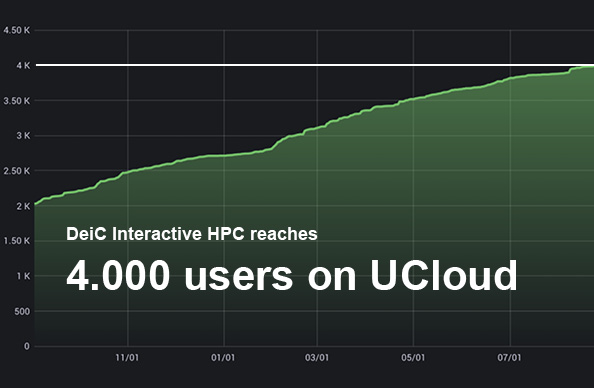
We’re approaching the end of the second year with DeiC Interactive HPC – and there are now 4000 users on UCloud!

During the first year with DeiC Interactive HPC, UCloud reached more than 2000 users. We’re glad that the interest in the platform has continued to grow throughout the second year.

Go to SDU eScience for full story

Categories
Interactive HPC Supercomputing UCloud

New UCloud release

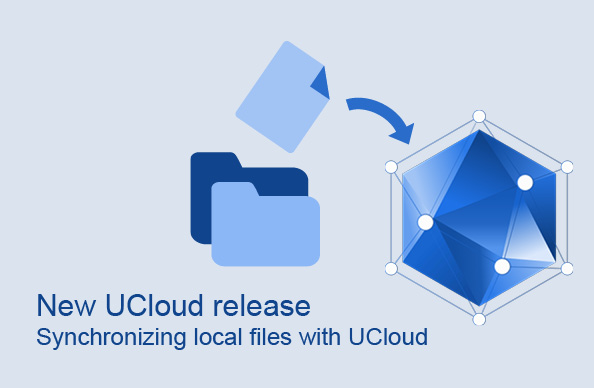
Since we discontinued our support for mounting your local folders onto UCloud using WebDAV, have we been in search of a way to allow the users of UCloud to work with their files locally without having to re-upload them to UCloud after every change. We are happy to announce that we now have a new solution that gives the possibility to synchronize your local files with your UCloud file storage.

Go to SDU eScience for more information on the release

Categories
Supercomputing UCloud

Call for applications for National HPC resources

As a researcher or Ph.d. Student at a Danish university you can now apply for resources on the national HPC centers, including the Danish part of EuroHPC LUMI.

The second call for applications for regular access to resources on the national HPC centers is now open. This includes applications for the Danish part of EuroHPC LUMI. The call is open for applications from all research areas.

As part of the use of the national e-infrastructures DeiC issues calls for applications on the use of the national resources. The projects are granted resources after application and on basis of assessment of research quality and technical feasibility.

The applications are evaluated by the appointed e-ressource committe and the grants are approved by the DeiC board.

Deadline for applications are 4th of October 2022 midnight, and the resources will be available for use from 1. January 2023.

For more information visit DeiC

Categories
Data Management Interactive HPC Research Supercomputing

Tilmeldingen til DeiC konference 2022 er åben

Nu er der åbnet for tilmeldingen til årets DeiC konference med fokus på modenhed og tilpasning.

Konferencens hovedtema er ”Alignment and Maturity: Implementing Research Infrastructure Solutions”.

Programmet er inddelt i fire spor: Data management, supercomputing (HPC), net og tjenester, samt sikkerhed. Inden for hvert spor vil der blive fokuseret på ’maturity’ og ’alignment’, samt strategier til løsninger på problemstillinger inden for forskningsinfrastrukturen.

Se program og tilmeld dig konferencen.